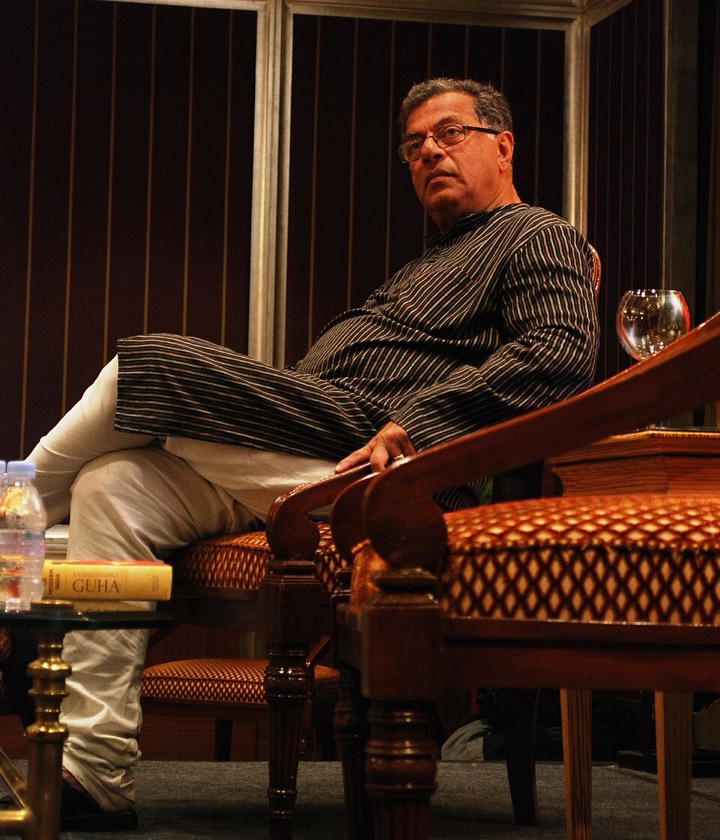
From Yayati to Rakshasa Tangadi, Girish Karnad spent nearly six decades turning myth, history and folk tale toward the present. Meet the playwright through his plays and the people who carried them to the stage.
THEATRE OF INDIA / PEOPLEEditorial draft · open to correction by the family and estateSources checked · 22 Oct 2026
01 / THE BEGINNING · 1961
An old story. A first play.
Girish Karnad was born on 19 May 1938 in Matheran, in present-day Maharashtra. His schooling began in Marathi, and after his family moved to Sirsi he came to know the travelling theatre troupes, the nataka mandalis.
He wrote his first play, Yayati (1961), while studying philosophy, politics and economics at Oxford as a Rhodes Scholar. Drawn from the Mahabharata, it tells of a king condemned to premature old age. Britannica traces to this play the use of history and mythology that would shape his work for decades.
Back in India, Karnad worked for Oxford University Press in Madras from 1963 to 1970, then turned to writing full time. In Madras he also joined the amateur theatre group The Madras Players.
Tughlaq (1964) follows Muhammad bin Tughlaq, the 14th-century Sultan of Delhi, from grand idealism to disillusionment. Britannica reads the ruler’s arc as an allegory of political ambition and failure in modern India, and many critics saw in it the decline of the Nehruvian era.
The National School of Drama Repertory Company staged it first under Om Shivpuri and later under Ebrahim Alkazi, who set his production at Delhi’s Purana Qila with Manohar Singh in the lead. Writing in The Hindu, Vikram Phukan credited Alkazi’s staging with carrying Karnad to national prominence.
The play kept travelling. B.V. Karanth’s Hindi translation became celebrated in its own right, and the Alkazi Theatre Archives hold brochures for later productions directed by K. Mandvane, Dinesh Thakur, Arvind Gaur and others.
Hayavadana (1971) drew on the Kathasaritsagara and Thomas Mann’s The Transposed Heads. A man with a horse’s head longs to become fully human, while a love triangle is upended by an accidental exchange of heads. Karnad shaped it with the folk theatre form of Yakshagana.
In 1987 and 1988 he was a visiting professor at the University of Chicago. Naga-Mandala (1988), built on a folk tale related to him by A.K. Ramanujan, framed an unhappy contemporary marriage in imagery drawn from Kannada folk tales. The Guthrie Theater in Minneapolis staged it in English, directed by J. Garland Wright.
Not everyone welcomed the turn to folk forms. The director Prasanna, remembering Karnad in 2019, said he was not fond of these plays, while acknowledging that many people liked Karnad for them. On stage, Hayavadana found new lives in Hindi, Marathi and German.
Taledanda (1990) returned to 12th-century Karnataka and the radical reform movement around the saint Basavanna, a minister at King Bijjala’s court. It won the Sahitya Akademi Award for Kannada in 1994, and Ebrahim Alkazi gave it its first staging, for the NSD Repertory Company.
Agni Mattu Male (The Fire and the Rain) went back to myth, and Prasanna directed it in Hindi. Tipu Sultan Kanda Kanasu (The Dreams of Tipu Sultan) was commissioned by BBC Radio and broadcast in Britain on 15 August 1997, the 50th anniversary of India’s independence.
He chaired the Sangeet Natak Akademi from 1988 to 1993, co-directed his own monologue Odakalu Bimba in the 2000s, and kept writing to the end: Rakshasa Tangadi, set in the last years of the Vijayanagara empire, was published in 2018. Karnad, who translated most of his plays into English himself, received the Jnanpith, the seventh for Kannada, and died in Bengaluru on 10 June 2019.
Writing, direction and performance are different contributions. Open a play to see the documented credits.
01THE FIRST PLAY · 1961
Yayati
ययातिWriting+
King Yayati is condemned to premature old age by the sage Shukracharya, in a story drawn from the Mahabharata. Feisal Alkazi has read the play as a story of children who sacrifice their own present for a parent’s happiness.
The people behind this production
Written in Kannada by Girish Karnad while he was at Oxford. B.R. Narayan’s Hindi translation was published in 1979. Hindi Wikipedia, citing the NSD’s Bharatiya Rangkosh, records its first Hindi staging in Kolkata in 1980, by Sangeet Kala Mandir under director Rajendra Kumar Sharma.
Britannica and The Hindu’s obituary date the play to 1961; Vikram Phukan’s tribute in The Hindu says it was written in 1960.
A 14th-century Sultan of Delhi sets out to remake his empire with grand ideals and ends in disillusionment. Critics have long read it as an allegory of the Nehru era.
The people behind this production
B.V. Karanth translated it into Hindi. The NSD Repertory Company staged it first under Om Shivpuri, in 1966 according to Hindi Wikipedia, and later under Ebrahim Alkazi at Delhi’s Purana Qila, with Manohar Singh in the lead.
Sources differ on the year of the Purana Qila staging: The Hindu gives 1972, while the Alkazi Theatre Archives date a production photograph to 1974.
Two friends and the woman they love are thrown into confusion when their heads are exchanged, while a man with a horse’s head longs to become fully human.
The people behind this production
B.V. Karanth translated the play into Hindi and directed its first Hindi staging, in New Delhi in 1972, according to Hindi Wikipedia. Satyadev Dubey’s Hindi production featured Amol Palekar, Amrish Puri and Sunila Pradhan, and Vijaya Mehta staged it in German and Marathi.
Karnad drew on the Kathasaritsagara, Thomas Mann’s The Transposed Heads and the conventions of Yakshagana. Years for the Dubey and Mehta productions are not asserted here.
An unhappy contemporary marriage, framed in imagery drawn from Kannada folk tales. Karnad built it on a folk tale related to him by A.K. Ramanujan.
The people behind this production
In English, the Guthrie Theater in Minneapolis staged it under director J. Garland Wright. In Hindi, B.R. Narayan’s translation was first staged in 1991 by Abhiyan, New Delhi, directed by Rajinder Nath, according to Hindi Wikipedia.
Wikipedia’s accounts of when the Guthrie staged the play are inconsistent, so no year is given for that production here.
In 12th-century Karnataka, the saint Basavanna serves as a minister at King Bijjala’s court while a radical reform movement grows around him. A backlash from the upper castes ends in a bloodbath.
The people behind this production
Ram Gopal Bajaj translated it into Hindi as Rakt Kalyan (रक्त कल्याण). Ebrahim Alkazi gave the play its first staging, for the NSD Repertory Company; Hindi Wikipedia dates that production to 1993.
The Sahitya Akademi lists Taledanda as its 1994 award-winning book in Kannada. Later Hindi stagings include Sunil Shanbag’s Rakt Kalyan.
Drawn from mythology, The Fire and the Rain follows a love between Nittilai, a tribal girl, and a Brahmin youth. When the gods grant its protagonist a boon that can save one life, his choice becomes the play’s final question.
The people behind this production
Ram Gopal Bajaj translated it into Hindi as Agni aur Barkha (अग्नि और बरखा). Prasanna directed the first Hindi staging, for the NSD Repertory Company; Hindi Wikipedia dates it to 1996. Wikipedia records that the Guthrie Theater commissioned the play.
Sources disagree on the year of the Kannada original: Hindi Wikipedia gives 1994, English Wikipedia 1995 and Britannica 1998, so none is asserted here. Prasanna has said he changed the ending in his production, and that Karnad did not like it.
A monologue for one performer. Manjula Nayak, a little-known Kannada writer, becomes famous through a bestseller in English, and then faces a double who questions that choice.
The people behind this production
Karnad wrote the play and directed it with K.M. Chaitanya. Arundhati Nag played Manjula in the Kannada and Hindi versions. The Hindi Bikhre Bimb (बिखरे बिम्ब) won 2008 META awards for Best Playwright, for Best Director, shared by Karnad and Chaitanya, and for Nag’s performance.
Wikipedia dates the Kannada premiere to 2005 at Ranga Shankara, Bengaluru; Hindi Wikipedia gives 2006 for the Kannada original. A separate English production, directed by Alyque Padamsee, starred Shabana Azmi.
A selected, source-linked repertoire. Dates appear only where established. Archive credits describe particular productions, not every staging.
THE PEOPLE / A SHARED STAGE
A name is never the whole cast.
Theatre travels through collaboration. These are a few of the connections that run through the documented work.
01 / IN HINDI AND ON FILM
B.V. Karanth
Translated Tughlaq and Hayavadana into Hindi and directed the first Hindi Hayavadana. On screen, he and Karnad co-directed Vamsha Vriksha (1971) and Tabbaliyu Neenade Magane.
Directed Tughlaq for the National School of Drama at Delhi’s Purana Qila, with Manohar Singh in the lead, and gave Taledanda its first staging for the NSD Repertory Company.
Staged Hayavadana in Hindi with Amol Palekar, Amrish Puri and Sunila Pradhan, a production The Hindu’s tribute counts among the noted Karnad stagings of its era. Hindi Wikipedia also credits him with a Hindi Bali, which he translated and directed in 1985.
Karnad’s screen career began with Samskara (1970), which he wrote for the screen and in which he played the lead; Pattabhirama Reddy directed it from U.R. Ananthamurthy’s novel. He went on to direct or co-direct films including Vamsha Vriksha (1971, with B.V. Karanth), Kaadu, Ondanondu Kaladalli (1978), Utsav (1984) and Kanooru Heggadithi (1999), and served as director of the Film and Television Institute of India in 1974 and 1975.
As an actor, he worked in Shyam Benegal’s Nishant and Manthan, led Basu Chatterjee’s Swami and played Swami’s father in the television series Malgudi Days, before later roles in films such as Iqbal (2005) and Tiger Zinda Hai. For many viewers he was a familiar face on screen; the plays are where to meet the writer.
Prepared by Theatre of India from the sources listed. This is an editorial draft, not an interview or an approved biography. The Karnad family and estate have not reviewed or endorsed it.
The profile deliberately separates the play from a particular production, and separates writing, direction and performance. It does not claim an exhaustive career record.
Review priorities: confirm the year of Ebrahim Alkazi’s Purana Qila Tughlaq (1972 or 1974); settle the dates of Agni Mattu Male and the Guthrie Naga-Mandala; add the first Kannada production of each play, with director and date; confirm any stage roles Karnad performed himself.
Profile version: 1.0. Photograph by Pushkarv via Wikimedia Commons, used under CC BY 3.0; the display crop and monochrome treatment are offered under the same licence. No endorsement is implied.
Girish Karnad ↗Britannica · Urnesha Bhattacherjee and Britannica Editors · checked 22 October 2026