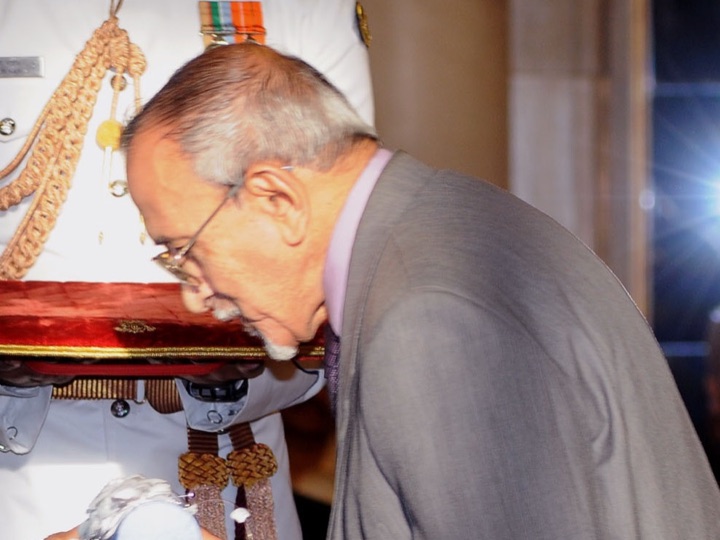
From a terrace theatre in Bombay to the battlements of Purana Qila. Meet the director, teacher and designer through the productions he staged and the school he built.
THEATRE OF INDIA / PEOPLEEditorial draft · open to correction by the family and the Alkazi FoundationSources checked · 22 Oct 2026
01 / THE BOMBAY YEARS · TO 1962
A student actor. A company of his own.
Ebrahim Alkazi was born on 18 October 1925 and grew up in Pune, in a family of Arab merchants: his father came from Saudi Arabia, his mother from Kuwait. In the early 1940s he moved to Bombay to study at St Xavier’s College and joined Sultan “Bobby” Padamsee’s English-language Theatre Group, where he was soon cast in Padamsee’s productions of Othello, Macbeth and Twelfth Night.
When his family moved to Pakistan after Partition, Alkazi stayed. He married Padamsee’s sister, Roshen, and went to London, where, having set out to study art, he won a place at the Royal Academy of Dramatic Art and was honoured by the British Drama League and the BBC. Accounts differ on the exact years. He came home with Roshen and led the Theatre Group before starting a company of his own.
In 1954 he founded the Theatre Unit with Roshen, bringing what Britannica calls a professional, technically informed approach to every part of the craft, from stage management to lighting and props. His school worked from a terrace above his fifth-floor flat, under the name Meghdoot Theatre. Gerson da Cunha remembered productions there of Medea, Volpone and Tartuffe, with Alkazi himself in the title role of the last.
In 1962 Alkazi moved to Delhi to lead the National School of Drama. He held the post until 1977, the longest tenure in the school’s history. Delhi meant working in Hindi and other Indian languages, and Gerson da Cunha records that he taught himself to use them as a director of speech would need to.
The course he designed reached beyond acting and direction to every aspect of stagecraft. The Alkazi Foundation describes an outlook that embraced classical Sanskrit drama, traditional and folk forms, modern plays in Indian languages and Western drama from the Greeks onward. In 1964 he founded the school’s Repertory Company, which began with four artistes, Ramamurthy, Meena Williams, Sudha Shivpuri and Om Shivpuri, and carried its productions across the country.
He also taught by building: students dug and built platforms for a theatre in the backyard of a rented house in Kailash Colony, where the school had moved. Among his students were Naseeruddin Shah, Om Puri, Nadira Babbar, Manohar Singh, Uttara Baokar and Rohini Hattangadi.
In 1963 Alkazi staged Dharamvir Bharati’s Andha Yug amid the ruins of Feroz Shah Kotla in Delhi. The anti-war verse play, set on the last day of the Kurukshetra war, arrived just after India had lost its war with China. Gerson da Cunha wrote of about a thousand people at the Kotla, and of a roar of “Krishna Maharaj ki jai” when Gandhari uttered her curse.
The school’s own stages followed the same instinct. In 1967, with 45 NSD students and the workshop’s technical staff, he designed an open-air theatre on the lawns of Rabindra Bhavan: a mud stage built around a tree, first made for Hori, from Premchand’s Godaan. It became Delhi’s Meghdoot Theatre, the name his Bombay terrace stage had carried.
At Purana Qila, the open-air theatre at the old fort was designed and supervised by Alkazi with the Archaeological Survey of India. There he staged Girish Karnad’s Tughlaq in 1972, and Andha Yug returned in 1974. Years earlier, in an essay for the journal Natya, he had written: “The past is in our blood; we do not need to carry it on our backs.”
Art had run alongside the theatre from the start. In 1950s Bombay, Alkazi mounted a series of exhibitions titled This is Modern Art, and he was close to Progressive Artists’ Group painters such as F.N. Souza, Akbar Padamsee and M.F. Husain, some of whom painted and designed sets for his plays.
Alkazi left the school in 1977 and stepped back from theatre. That same year he and Roshen set up Art Heritage, a gallery in New Delhi, where, as director, he was among the first promoters of modern artists such as Husain, Tyeb Mehta and Akbar Padamsee. He also built one of the world’s largest private collections of historical photographs, centred on 19th- and early 20th-century images of India, Myanmar and Sri Lanka.
The Alkazi Foundation for the Arts, which he chaired, holds that photography collection and the Alkazi Theatre Archives. His honours included the Sangeet Natak Akademi Award for direction (1962), the Padma Shri (1966), the Padma Bhushan (1991) and the Padma Vibhushan (2010). He died in New Delhi on 4 August 2020. In a 1995 interview he reflected that what a life leaves behind is a memory: “You live in the minds of others, in the memories of others.”
Writing, direction and performance are different contributions. Open a play to see the documented credits.
01BOMBAY · 1952
Antigone
एंटीगनीDirectionPerformance+
Jean Anouilh’s 1944 reworking of Sophocles sets Antigone’s refusal against Creon’s defence of authority. Alkazi directed it in Bombay and took the role of the Chorus himself.
The people behind this production
Playwright: Jean Anouilh, after Sophocles. Gerson da Cunha, who acted in the production, names Pheroza Cooper as Antigone and Hamid Sayani as Creon.
The year comes from da Cunha’s recollection, which does not name the producing company or the venue. He remembered movement that was choreographed rather than simply blocked.
Mohan Rakesh’s three-act play follows the poet Kalidasa from a Himalayan village to fame at Ujjayini, and counts the cost to Mallika, the woman who urged him to go.
The people behind this production
Playwright: Mohan Rakesh. Wikipedia records Alkazi’s production at the National School of Drama, Delhi, in 1962, after the first staging by Shyamanand Jalan’s Anamika in Calcutta in 1960.
Wikipedia credits this production with establishing Rakesh as the first modern Hindi playwright. Cast details are not asserted here.
Dharamvir Bharati’s anti-war verse play is set on the last day of the Kurukshetra war. Amid the ruins of Feroz Shah Kotla, Alkazi’s staging turned on the futility of war and the aftermath of violence.
The people behind this production
Playwright: Dharamvir Bharati. According to Wikipedia, Satyadev Dubey staged the play in 1962 and then sent the script to Alkazi.
The Alkazi Foundation records a second presentation at Purana Qila in 1974. Gerson da Cunha recalled an audience of about a thousand at the Kotla.
Shakespeare’s King Lear, the tragedy of an ageing king who divides his kingdom among his daughters, presented by Alkazi for the National School of Drama in Urdu translation.
The people behind this production
Playwright: William Shakespeare. Urdu translation by Majnoon Gorakhpuri, as listed in MIT Global Shakespeares’ chronology of King Lear in India.
MIT’s history of the play in India calls the production a benchmark. Cast and venue details are not asserted here.
From Premchand’s novel Godaan: the hardships of a poor peasant couple, Hori and Dhaniya, in rural north India under colonial rule. Alkazi wrote that in presenting a play such as Hori, “the students erect a village.”
The people behind this production
Source novel: Premchand’s Godaan (1936). The Alkazi Theatre Archives describe the stage version as Alkazi’s adaptation, performed by his NSD students at the Meghdoot Theatre, Delhi.
The open-air theatre was first built for this production, designed by Alkazi with 45 students and the workshop staff. The archive names no separate dramatist, so the adaptation credit is flagged for review.
Badal Sircar’s play opens with a man pleading his innocence to an unseen force from the 30th century, then summons the spirits of people tied to the 1945 bombings of Hiroshima and Nagasaki to a mock trial.
The people behind this production
Playwright: Badal Sircar, from his play Teesveen Shatabdi (1966). Produced by the NSD Repertory Company in 1970 and directed by Alkazi.
The production brochure records that Sircar studied the staging closely and felt it kept the essence and meaning of his play. Venue and cast are not asserted here.
Girish Karnad’s play follows the 14th-century sultan Muhammad bin Tughlaq from his rise to his downfall. Alkazi set it against the battlements of Purana Qila, and Britannica notes it is generally considered his finest production.
The people behind this production
Playwright: Girish Karnad, who wrote it in Kannada in 1964. Manohar Singh played the title role. The open-air theatre at the fort was designed and supervised by Alkazi with the Archaeological Survey of India.
The Alkazi Theatre Archives hold images of Purana Qila stagings in 1972 and 1974 and label the production Hindi; Mumbai Theatre Guide calls it an Urdu version. Wikipedia notes an earlier NSD student production in 1966, not credited here.
Karnad wrote Tughlaq in Kannada in 1964, using a 14th-century sultan to read the politics of the Nehru years. Mumbai Theatre Guide calls Alkazi’s Purana Qila staging the play’s most celebrated production.
Sultan Padamsee’s sister and Alkazi’s wife. She founded the Theatre Unit with him in 1954 and designed costumes for his plays; in 1977 the two set up the Art Heritage gallery in New Delhi.
Both trained under Alkazi and went on to leading places in Indian cinema, theatre and television. Britannica names them among the actors he groomed; Scroll, among the talents he nurtured.
Prepared by Theatre of India from the sources listed. This is an editorial draft, not an interview or an approved biography. The Alkazi family and the Alkazi Foundation for the Arts have not reviewed or endorsed it.
The profile deliberately separates the play from a particular production, and separates writing, direction and performance. It does not claim an exhaustive career record.
Review priorities: confirm when Alkazi trained at RADA and returned to Bombay, and the Theatre Unit’s founding year and members; identify the company and venue of the 1952 Antigone; settle the language, translator and cast of the Purana Qila Tughlaq and who directed the 1966 NSD student staging; add cast lists for Ashadh Ka Ek Din and Raja Lear; confirm the adaptation credit for Hori; and source a portrait the family or the Foundation can license.
Profile version: 1.0. Photograph by President’s Secretariat via Wikimedia Commons, used under GODL-India; the display crop and monochrome treatment are offered under the same licence. No endorsement is implied.
Ebrahim Alkazi ↗Britannica · The Editors of Encyclopaedia Britannica · updated 14 October 2025