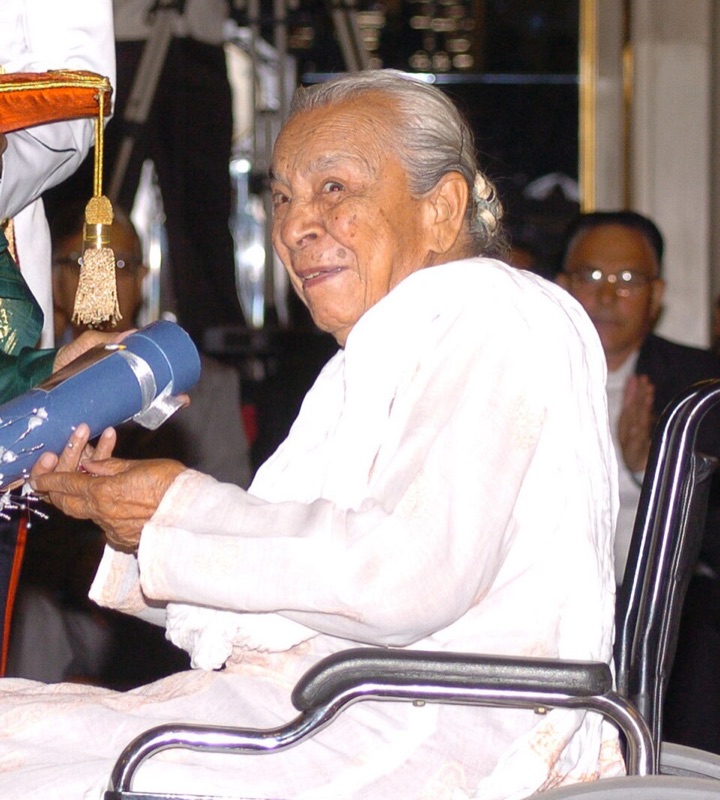
From Uday Shankar’s dance company to Prithvi Theatres, and a reunion on stage with her sister decades later. Meet the dancer, actor and choreographer through the stages she shared.
THEATRE OF INDIA / PEOPLEEditorial draft · open to correction by the familySources checked · 22 Oct 2026
01 / THE DANCER · FROM 1935
A backstage visit. A telegram to Japan.
Zohra Sehgal grew up in an aristocratic Muslim family in northern India, one of seven children, and studied at Queen Mary College in Lahore. A life on the stage was not the expected path. In Germany in the early 1930s, she trained with the dance pioneer Mary Wigman.
When Uday Shankar’s company toured Europe, she went to a performance and met him backstage, as she later recounted to the dance critic and historian Ashish Khokar. Back in India, a telegram summoned her to join the company for a tour of Japan. She began dancing with Shankar in 1935.
The tours took her across Japan, Egypt, Europe and the United States. Britannica remembers her as Shankar’s dance partner in the 1930s, and counts her among the artists shaped by the cultural centre he founded at Almora, where she also taught.
At Almora she met Kameshwar Sehgal, a painter, scientist and dancer eight years her junior. They married in 1942, despite considerable opposition, and opened a dance school in Lahore before moving on to Bombay.
In Bombay the couple joined the Indian People’s Theatre Association, a progressive movement of writers, poets, film-makers, actors and artists. From 1945, Zohra also spent fourteen years with Prithviraj Kapoor’s touring company, Prithvi Theatres.
Accounts of her place in that company differ in emphasis. The Guardian remembers her as one of its leading ladies, touring plays that argued for communal harmony after Partition. In Khokar’s account she was its dance director, and she told him she never landed the main roles. Britannica praises her emotional range as rare among actresses on the Hindi stage.
After Kameshwar’s death, Sehgal moved to Delhi to head the newly founded Natya Academy. In 1962 a British Drama League scholarship took her and their two children to London.
London began backstage. The Guardian records that she worked as a dresser at the Old Vic and took small parts in the theatre, and she taught dance at Ram Gopal’s school in Chelsea. Her memoir Stages (1997), as Ramachandra Guha described it, follows her from Shankar and Kapoor to the London stage of the 1960s and 1970s.
India did not forget her stage work. In 1963, the year after she left, the Sangeet Natak Akademi gave her its award for acting, which its list records under Urdu theatre.
Shahid Nadeem’s Ek Thi Nani, presented by Lahore’s Ajoka Theatre, draws loosely on the lives of Zohra and her younger sister Uzra Butt, a Prithvi star who moved to Pakistan in 1964. When the sisters performed it in Lahore in 1993, it was their first time on a stage together in four decades.
On 3 November 2004, Prithviraj Kapoor’s birth anniversary, Ajoka’s revival brought the sisters, then 92 and 87, to Prithvi Theatre in Mumbai. When someone in the audience called for Abhi To Main Jawan Hoon, Zohra sat down again and recited Hafeez Jalandhari’s nazm from memory.
In the early 2000s she also joined Shabana Azmi and Nandita Das in Roysten Abel’s The Spirit of Anne Frank. The Sangeet Natak Akademi named her a Fellow for 2004, for her contribution to theatre arts, and in 2010 she received the Padma Vibhushan. She died in New Delhi on 10 July 2014, aged 102.
Writing, direction and performance are different contributions. Open a play to see the documented credits.
01THE FIRST COMPANY · FROM 1935
Uday Shankar’s company
उदय शंकर की नृत्य मंडलीDance+
Shankar built his dance dramas from classical and folk sources, shaped by a modern eye, and his touring company carried them to audiences in Europe and the United States.
The people behind this production
Dancer with the company from 1935. The Hindu’s obituary records her performing across Japan, Egypt, Europe and the United States; Britannica describes her as Shankar’s dance partner in the 1930s.
The sources consulted do not name the individual dances she performed, and accounts differ on when her touring years ended. She later taught at his cultural centre in Almora.
A left-wing theatre movement of progressive writers, poets, actors, film-makers and artists, and a dominant force in Indian culture in the 1940s.
The people behind this production
BBC News says she stepped into acting by joining IPTA. The Hindu’s obituary says she acted with IPTA and with Prithvi Theatre over fourteen years.
No individual IPTA stage production is credited here, because the sources consulted describe this work only in general terms. Her IPTA films appear in the screen section.
Prithviraj Kapoor’s Bombay company, founded in 1944, toured India with Hindi plays until it closed in 1960. Kapoor played the lead in each of its eight productions.
The people behind this production
The Guardian names her as one of the company’s leading ladies after Partition, touring plays that advocated communal harmony. In Ashish Khokar’s account for The Hindu, she was its dance director from 1945 to 1959.
Her years with the company are well attested, but the sources consulted do not assign her roles in particular productions, so no single play is credited to her here.
Two sisters, one who left for Pakistan and one who stayed in India, collide when their granddaughter Sabeen is offered a television role. One grandmother bans music and dance at home; the other urges the girl to create.
The people behind this production
Written by Shahid Nadeem and presented by Lahore’s Ajoka Theatre. In the 2004 revival at Prithvi Theatre, Mumbai, directed by Madeeha Gauhar, Zohra Sehgal and Uzra Butt played the two grandmothers and their grandniece Samiya Mumtaz played Sabeen.
The sisters first performed it together in Lahore in 1993. An English version, A Granny for All Seasons, was given a performance reading at UCLA in November 2001 by a different cast. The title also appears as Aik Thi Nani.
Five women meet in a compartment on a night train. Made in the years after the 2002 Gujarat riots, the play takes up violence shaped by gender and caste.
The people behind this production
Directed by Roysten Abel. The Hindu lists Shabana Azmi, Nandita Das and Zohra Sehgal in the cast.
Ramachandra Guha, who saw it in Bangalore, recalled her playing, for once, an embittered old woman of the Hindu right, and drawing most of the applause. Sources give 2002 and 2003 for the production, so no premiere date is asserted here.
Founder of Prithvi Theatres in 1944 and the lead in all eight of its productions. She toured with his company from 1945 to 1959, and in 2004 returned to the Prithvi stage in Mumbai on his birth anniversary.
Painter, scientist and dancer, whom she met at Shankar’s arts centre in the Himalayan foothills. They married in 1942, ran a dance school in Lahore and moved to Bombay, where both joined IPTA.
In Britain she became a familiar television face, from Doctor Who in the mid-1960s and BBC programmes for new migrants and the 1977 serial Padosi, to The Jewel in the Crown (1984) and Channel 4’s Tandoori Nights. Films followed, among them My Beautiful Laundrette, Bhaji on the Beach and Bend It Like Beckham.
In India her screen life began with IPTA’s Dharti Ke Lal and Chetan Anand’s Neecha Nagar in 1946, and she choreographed for Guru Dutt’s Baazi and Raj Kapoor’s Awaara. Late in life she was cast again and again as a grandmother, in films such as Dil Se.. and Veer-Zaara, and played Amitabh Bachchan’s mother in Cheeni Kum.
Prepared by Theatre of India from the sources listed. This is an editorial draft, not an interview or an approved biography. Zohra Sehgal’s family has not reviewed or endorsed it.
The profile deliberately separates the play from a particular production, and separates writing, direction and performance. It does not claim an exhaustive career record.
Review priorities: identify her roles in individual Prithvi Theatres and IPTA productions and the Uday Shankar dances she performed; reconcile conflicting accounts of her birthplace (Saharanpur or Rampur) and of the years of her marriage (1942 or 1943), her husband’s death (1959 or 1952) and her return to India (1987 or the 1990s); confirm when The Spirit of Anne Frank premiered.
Profile version: 1.0. Photograph by President’s Secretariat via Wikimedia Commons, used under GODL-India; the display crop and monochrome treatment are offered under the same licence. No endorsement is implied.