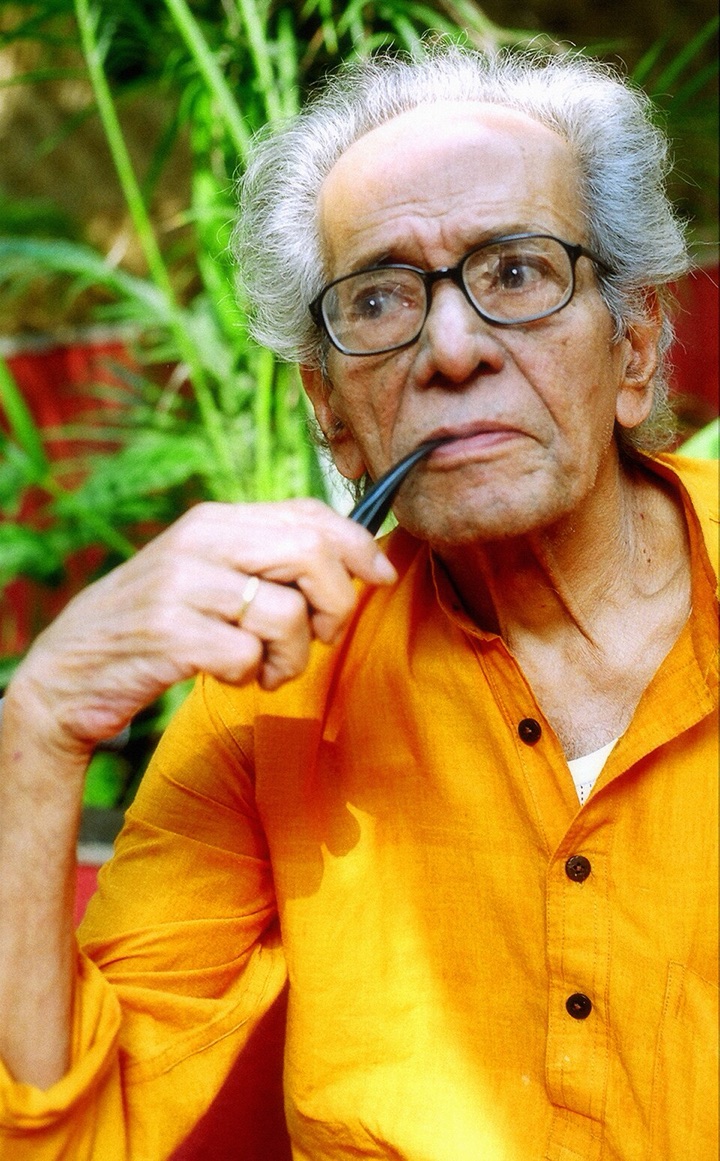
From the songs of Agra Bazar to the truthful thief of Charandas Chor. Meet the playwright, director and actor who built a new Indian theatre with the nacha performers of Chhattisgarh.
THEATRE OF INDIA / PEOPLEEditorial draft · open to correction by the family and Naya TheatreSources checked · 22 Oct 2026
01 / BOMBAY AND IPTA · 1945
A poet finds the people’s stage.
Habib Tanvir was born Habib Ahmed Khan in Raipur on 1 September 1923. He wrote poems early under the name Tanvir, and the name stayed with him. So did the Chhattisgarhi songs of his childhood: Sudhanva Deshpande told Scroll that Tanvir’s work notebooks from the late 1950s to the early 1970s were full of songs he had collected since he was a boy.
After college in Nagpur and studies at Aligarh Muslim University, he moved to Bombay in 1945, drawn by the possibility of a career in films. He worked as an All India Radio producer, but his real schooling came from the Progressive Writers’ Association and the Indian People’s Theatre Association (IPTA), where he worked as a writer and actor and met folk forms such as Tamasha, Lavani and Bhavai.
When the left movement weakened and IPTA faltered, he moved to Delhi in 1954, a move he explained as a way to escape the temptation of film acting. He wrote and staged plays with schoolchildren, joined Qudsia Zaidi’s Hindustani Theatre and made Agra Bazar, first performed on Jamia Millia Islamia’s Okhla campus with teachers, students and Okhla villagers in the cast.
In the mid-1950s Tanvir went to England. Naya Theatre’s account of its founder records training in acting at the Royal Academy of Dramatic Art in London, and in direction and production at the Bristol Old Vic Theatre School. At RADA, Sudhanva Deshpande has written, he honed his craft but was not inspired by rigid Western notions of time, space and action; Sameera Iyengar notes that the Old Vic had a lasting effect on his thinking.
Then came the road. He travelled through Europe, earning his way through writing and performance, and famously sang Chhattisgarhi songs in bars for money. In Berlin he hoped to meet Bertolt Brecht, who died in August 1956 before a meeting could happen. Tanvir stayed nearly eight months, watching the Berliner Ensemble’s productions, sitting in on rehearsals and discussing Brecht’s practice with Helene Weigel and Elisabeth Hauptmann.
He came home with two convictions. Brecht’s use of song as narrative had left its mark, and, as Tanvir would stress, Europe taught him that meaningful theatre had to be built close to the traditions of one’s own people. He returned to India in 1958.
His first production after Europe, Mitti ki Gaadi, from Shudraka’s Sanskrit classic Mrichchhakatika, put six village artists from Chhattisgarh on stage. He had watched nacha, the region’s all-night form of comedy, music, dance and drama, and invited its performers to join him in Delhi. In 1959 Tanvir and Moneeka Misra, his partner in life and theatre, founded Naya Theatre.
Sameera Iyengar describes some thirteen years of experiment that kept failing: Western blocking and a Hindustani script hemmed in actors whose brilliance lay in improvisation. A Sangeet Natak Akademi award, and commissioned performances of Agra Bazar from Delhi to Srinagar, helped him bring his performers back. Then he changed his method, working in Chhattisgarhi and improvising with the actors before fixing a scene. His two keys, he said, were “mother tongue and freedom of movement.”
The new way of working produced Gaon ka Naam Sasural, Mor Naam Damaad and then, in 1975, Charandas Chor, which won a Fringe First at the Edinburgh Festival in 1982. Naya Theatre toured for some fifty years under Tanvir’s leadership, with generations of nacha performers at its core.
Naya Theatre began in Delhi and later moved its base to Bhopal, and its repertoire kept widening: Bahadur Kalarin and Shajapur ki Shantibai, from Brecht’s The Good Person of Szechwan, in 1978; Tanvir’s own Hirma ki Amar Kahani; Asghar Wajahat’s Jis Lahore Nai Dekhya; Tagore in Raj Rakt; and Zahreeli Hawa, on the Bhopal gas tragedy.
The theatre stayed political. Ponga Pandit, a 1930s nacha satire on a corrupt priest, drew the anger of Hindutva groups who accused him of denigrating Hinduism. In 2003, Nilanjana S. Roy reported, protesters in Bhopal threw rotten eggs at the stage and broke chairs. Tanvir stood his ground.
Recognition came steadily: the Sangeet Natak Akademi Award in 1969, the Padma Shri in 1983, the Akademi’s Fellowship in 1996 and the Padma Bhushan in 2002, with a nominated term in the Rajya Sabha from 1972 to 1978. He died in Bhopal on 8 June 2009. His daughter, Nageen Tanvir, is among the few keeping the company’s songs alive, and Naya Theatre’s website now names Ramchandra Singh as its director.
Writing, direction and performance are different contributions. Open a play to see the documented credits.
01THE FIRST LANDMARK · 1954
Agra Bazar
आगरा बाज़ारWritingDirection+
In a slumping Agra market, a cucumber seller wants a poem to help his trade. Several poets refuse; Nazir Akbarabadi obliges, and soon the whole bazaar is singing his verses. Nazir himself never appears on stage.
The people behind this production
Written and staged by Tanvir in 1954. The first production cast teachers and students of Jamia Millia Islamia alongside villagers from nearby Okhla.
Naya Theatre records revivals in 1970, with some Chhattisgarhi actors, and in 1976. The 1954 date refers to the first staging.
Shudraka’s Sanskrit classic Mrichchhakatika, made in Hindustani: the production in which Tanvir first brought village performers from Chhattisgarh onto his stage.
The people behind this production
Directed by Tanvir after his return from Europe in 1958, with six village artists from Chhattisgarh in the cast. Sangeet Natak Akademi’s citation describes it as an adaptation of Mrichchhakatika and counts it among his adaptations of Sanskrit classics.
Javed Malick calls it a first and limited engagement with folk performers; the full partnership came later. In later productions Fida Bai played Basant Sena.
At the Chher-Chhera festival, Jhanglu falls for Manti, but her father marries her to a rich old sarpanch. Jhanglu and his friends arrive in disguise, fool the groom and carry Manti away, and the play ends in songs celebrating love.
The people behind this production
Created by Naya Theatre under Tanvir’s direction from an existing nacha piece, once the company had begun working in Chhattisgarhi and through improvisation. Fida Bai played Manti.
Sources give its premiere as 1972 or 1973, so no single year is asserted here. Its song Saas gaari deve was later reworked as a film song in Delhi-6.
A thief promises his guru never to eat off gold plates, ride an elephant at the head of a procession, marry a queen or accept a throne, and then, at the guru’s request, never to lie. When a queen’s offers arrive, the one promise he will not break costs him his life.
The people behind this production
Tanvir’s director’s note says he wrote it “with my folk actors, all of them improvisers, rather than with a pen.” The story comes from a Rajasthani folk tale told by Vijaydan Detha. Govind Ram Nirmalkar was feted as Charandas, and Fida Bai played the queen.
The production won a Fringe First at the Edinburgh Festival in 1982. The Wire publishes a 2002 photograph of Tanvir himself as the Rajpurohit; that records a later performance, not the original cast.
A pandit sets up rituals to keep his sweeper out of worship, and the comedy becomes a pointed attack on hypocrisy and untouchability.
The people behind this production
Composed in the 1930s by the Chhattisgarhi folk artists Sukhram and Sitaram, and staged by Tanvir’s company for decades. Tanvir did not write it. Govind Ram Nirmalkar was among its performers.
In 2003 Sangh Parivar activists picketed performances, and in Bhopal protesters threw rotten eggs at the stage and broke chairs. Tanvir stood his ground.
Drawn from a historical event: a headstrong tribal ruler clashes with people who want to replace his community’s way of life with new ideals of democracy, with disastrous results.
The people behind this production
Sangeet Natak Akademi’s citation lists it as Tanvir’s own play among his important productions. Govind Ram Nirmalkar is recorded among its performers.
Seagull Books publishes it in English as The Living Tale of Hirma and dates it to 1985. The historical figure behind the play is not named in the sources used here.
कामदेव का अपना, बसंत ऋतु का सपनाAdaptationDirection+
Oberon and Titania quarrel over a child, Puck’s mischief turns a village actor into an ass, and the rustic players finally present their Pyramus and Thisbe.
The people behind this production
Tanvir’s adaptation of Shakespeare’s A Midsummer Night’s Dream, staged by Naya Theatre, which still lists it in its repertoire.
Sameera Iyengar writes that a version was made without the court characters after a planned British collaboration fell through; Naya Theatre’s current synopsis includes the duke’s wedding. Version detail is flagged for review.
A selected, source-linked repertoire. Dates appear only where established. Archive credits describe particular productions, not every staging.
THE PEOPLE / A SHARED STAGE
A name is never the whole cast.
Theatre travels through collaboration. These are a few of the connections that run through the documented work.
01 / CO-FOUNDER
Moneeka Misra
Tanvir’s wife and professional partner, and a theatre director in her own right. Together they founded Naya Theatre in 1959, and she supported its work creatively and logistically through years when funding was scarce.
Feeta Bai Markam, better known as Fida Bai, trained in nacha under Dau Mandraji. Tanvir first noticed her at a nacha workshop in Raipur in 1972. She played the queen in Charandas Chor and the title roles in Bahadur Kalarin and Shajapur ki Shantibai, and left the stage too soon after losing her voice.
A nacha performer from Rajnandgaon district who joined Naya Theatre in 1971 and stayed until 2005. He was feted as Charandas and also played in Ponga Pandit and Agra Bazar. He received the Padma Shri in 2009.
Tanvir went to Bombay in the 1940s hoping to act in films, and he did appear in a few. By the early 1950s, he later explained, he had concluded that the cinema of the day gave artists no autonomy and that his medium was the theatre.
Film still found its way to his work. Shyam Benegal’s 1975 Charandas Chor, starring Smita Patil and Lalu Ram, was based on his play, used his lyrics and cast him as a magistrate. He also appeared in Richard Attenborough’s Gandhi and played Bahadur Shah Zafar in Mangal Pandey: The Rising (2005).
Prepared by Theatre of India from the sources listed. This is an editorial draft, not an interview or an approved biography. The Tanvir family and Naya Theatre have not reviewed or endorsed it.
The profile deliberately separates the play from a particular production, and separates writing, direction and performance. It does not claim an exhaustive career record.
Review priorities: confirm dates where sources differ, including his departure for England (1954 or 1955), the premiere of Gaon ka Naam Sasural, Mor Naam Damaad (1972 or 1973) and the company’s move from Delhi to Bhopal; confirm the original stage cast of Charandas Chor; clarify which version of Kamdeo ka Apna Basant Ritu ka Sapna each source describes; add the historical figure behind Hirma ki Amar Kahani with evidence.
Profile version: 1.0. Photograph by Sanjay Vaidya via Wikimedia Commons, used under CC BY-SA 4.0; the display crop and monochrome treatment are offered under the same licence. No endorsement is implied.